
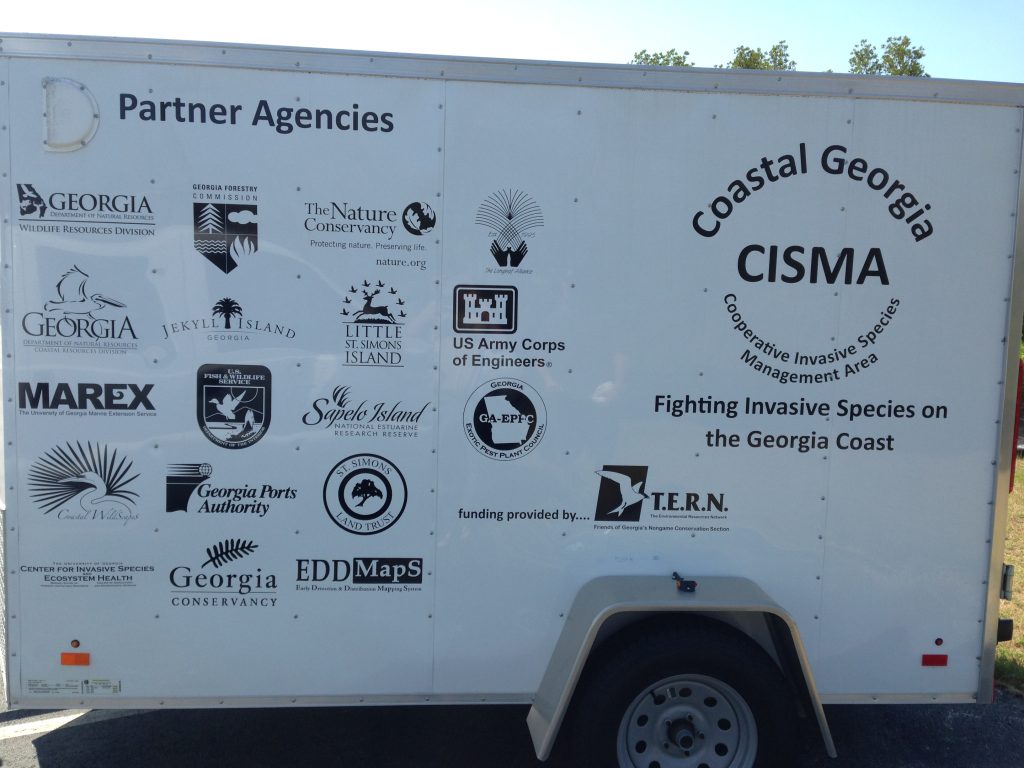
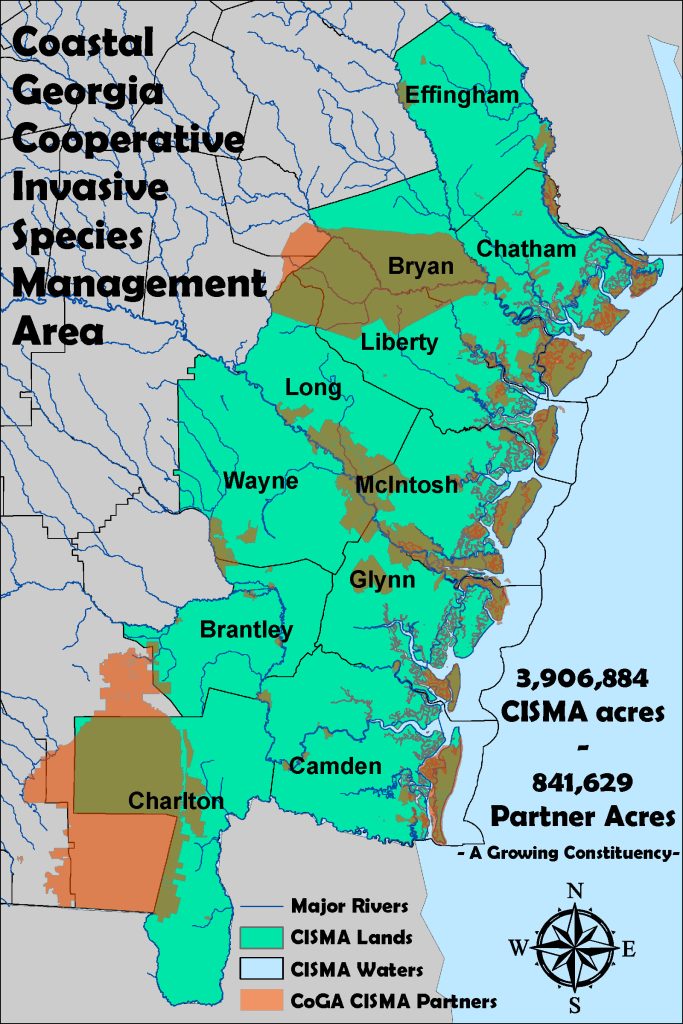
The Coastal Georgia Cooperative Invasive Species Management Area (CoGA CISMA) was established in March 2012 to work across Federal, State, Local, and private lands for invasive species management in Camden, Glynn, McIntosh, Liberty, Bryan, Chatham, Effingham, Long, Wayne, Brantley & Charlton counties. The CoGA CISMA is the first geographically based CISMA formed in Georgia.
The CoGa CISMA covers approximately 3,900,000 acres with over 100 miles of coastline, with approximately 841,600 acres, or 22% of the land, considered to be conservation land and represents most of the area managed by our partner agencies. By focusing on the ecologically significant coastal landscape, CoGA CISMA strives to manage invasive species more effectively and increase early detection and rapid response efforts.

The CoGA CISMA meets annually in a central location in the 11 county area. Public and private land managers within the 11 county area are welcomed and invited to attend. For more information, please contact the CoGA CISMA coordinator Eamonn Leonard at eamonn.leonard@dnr.ga.gov.

A Georgia coast where “non-native invasive species” minimally impact the sustainability and resilience of ecological and economic systems.
To implement a comprehensive, cooperative approach across boundaries to address the threats of “non-native invasive species” to the lands and waters within the Coastal Georgia CISMA. By addressing occurrences, impacts, early detection/rapid response, education/outreach, and investigation of pathways for infestation.
The most cost-effective way to address invasive species is to prevent them from reaching the CISMA in the first place. If, despite prevention efforts, invasive species reach the CISMA, early detection programs can help locate and eradicate those invasive species before they become widely established. If invasive species elude early detection and establish and spread in the CISMA or are part of a previous invasion, control and management programs to monitor and minimize their negative impacts to the economy and environment will be necessary, but these efforts can be very costly. The sooner we act the more effective and less costly our efforts will be (adapted from the Indiana Invasive Species Task Force 2008).
| Name | Email Address | Organization |
|---|---|---|
| Eamonn Leonard | eamonn.leonard@dnr.ga.gov | GA DNR Wildlife Conservation |
| Erin Cork | erin.cork@dnr.ga.gov | GA DNR Wildlife Conservation |
| Tom Bliss | tbliss@uga.edu | UGA MAREX Skidaway |
| Wayne Harris | billy_harris@fws.gov | US Fish and Wildlife Service |
| Colby Peffer | colby.peffer@dnr.ga.gov | Sapelo Island National Estuarine Research Reserve |
| Jessica Warren | jkwarren@uga.edu | UGA Cooperative Ext |
| Yank Moore | ymoore@jekyllisland.com | Jekyll Island Authority |
| Scott Coleman | scottc@littlessi.com | Little St. Simon Island |
| Kevin Brazell | kbrazell@southernco.com | Georgia Power |
| Jim Page | jim.page@dnr.ga.gov | GA DNR Fisheries |
| Eddie Leonard | eddie.leonard@dnr.ga.gov | GA DNR Coastal Resources Div. |
| Jeffrey Butler | jbutler@dot.ga.gov | Georgia DOT (Agronomist manager) |















Thank you to the National Fish and Wildlife Foundation – Pulling Together Initiative for awarding the CoGA CISMA with two $50,000 grants in 2013 and 2015. The 2013 grant helped kick start our CISMA, with funding for one co-coordinator, two Student Conservation Association (SCA) interns for 3 years, herbicides and supplies, brochure printing, and website establishment. The 2015 grant helped us extend our SCA internship program two more years, maintain our website, and establish a private landowner cost-share program. The Nature Conservancy and the GA DNR Nongame Conservation Section provided matching funds for this grant.
We would also like to thank TERN (The Environmental Resources Network) for providing three grants in 2013, 2014, and 2016 that funded the purchase of a box trailer, chainsaws, hedge trimmers, GPS units, safety equipment and other supplies, as well as longleaf pine seedlings for a restoration site.